

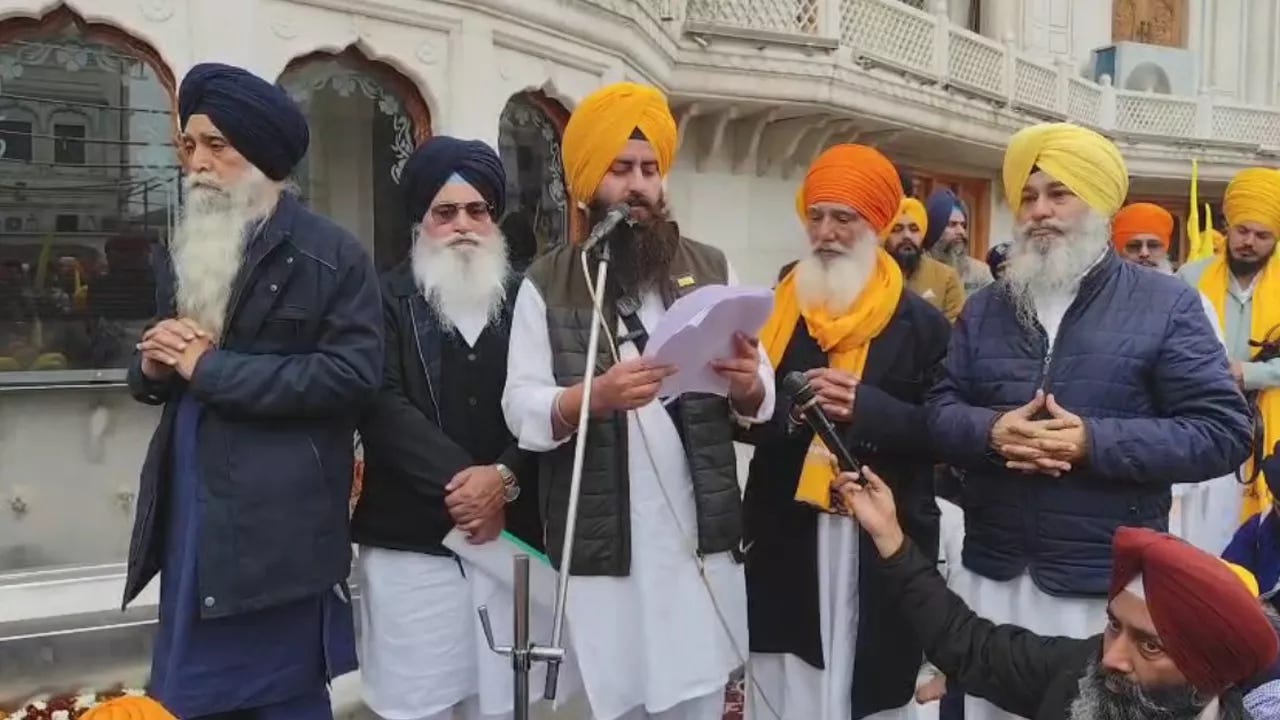
Marking the fortieth anniversary of the historic 1986 Sarbat Khalsa, Sikh jujharoos and leadership from Dal Khalsa, the Panth Sewak Collective, Shiromani Akali Dal (Amritsar), and the Bhai Jagtar Singh Hawara Committee gathered on January 26, 2026 and publicly announced concrete steps toward rebuilding panthic leadership in the political lineage of that moment. The actions taken by panthic organizations in Punjab this week must be understood as a critical first step toward re-establishing sovereign Sikh leadership capable of guiding the present phase of the Khalistan sangarsh. The joint declaration is being republished below in English:
13 Magh 557 Nanakshahi
26 January, 2026
Commitment to Collective Decision-Making, Self-determination, and Sovereignty
ਹੁਣਿਹੁਕਮੁਹੋਆਮਿਹਰਵਾਣਦਾ॥
ਪੈਕੋਇਨਕਿਸੈਰਞਾਣਦਾ॥
ਸਭਸੁਖਾਲੀਵੁਠੀਆਇਹੁਹੋਆਹਲੇਮੀਰਾਜੁਜੀਉ॥
-ਗੁਰੂ ਗ੍ਰੰਥ ਸਾਹਿਬ ਜੀ, ਅੰਗ ੭੪
Now under the command of the Gracious:
No one causes grief to anyone.
All live in comfort; this is the benevolent halemi Raj.
- Guru Granth Sahib, Ang 74
To rejuvenate the sacred glory of Guru Granth Sahib and Guru Khalsa Panth; to uphold the unique and distinct identity of the Sikh people; to affirm the sui generis and inherent patshahi (Sikh sovereignty) of the Guru Khalsa Panth; and to collaborate across Panthic jathebandiyan (organizations) across the world for the creation of an environment in which Sikh aspirations, principles, and objectives are honoured and given opportunity to flourish, this gathering before Sri Akal Takht Sahib, Sri Amritsar, assembled at the call of four pro-freedom Sikh bodies: Dal Khalsa, Shiromani Akali Dal (Amritsar), Panj Pardhani Jatha and Bhai Jagtar Singh Hawara Jatha, was convened to observe the fortieth Sarbat Khalsa Remembrance Day, and to affirm their commitment to Collective Decision-Making, Self-Determination, and Sovereignty before the entire Khalsa Panth and Gursangat
Assembled in remembrance of the Sarbat Khalsa held 40 years ago, the Guru Khalsa Panth’s time-honoured and tested institution for collective deliberation—and conscious of our responsibility to future generations, this gathering reaffirms its commitment to furthering our sangarsh (struggle) and international advocacy rooted in gurmat and Khalsa traditions.
This Panthic gathering:
Recognises that the Sarbat Khalsa and Gurmatta are the Guru Khalsa Panth’s legitimate and enduring institutions for collective decision-making, guidance, and accountability;
Draws inspiration and guidance from the Declaration of 29 April 1986, which declared sovereignty as a Gurmat-driven response to state violence by the Indian state, grounded in its vision of ‘Panth ki Jit’ (Victory for the Panth) and ‘Sarbat da Bhala’ (Welfare of All), social egalitarianism, the protection of religious freedoms, self-determination, and human rights norms leading to participatory decision-making under Panthic unity;
Affirms the distinct spiritual, cultural, and political character of the Guru Khalsa Panth; the call of the First Sovereign Guru Nanak Sahib for the creation of the ‘Third Nirmal Panth’; the daily proclamation of ‘Raj Karega Khalsa’ (Khalsa Shall Rule) every morning and evening in individual prayer and Sangat (Congregation); the ideals of the unique society-polity envisioned in Begampura-Halemi Raj; and the discipline of Bani-Bana as binding principles;
Declares with full conviction that the Sikh struggle, especially from 1978/1984 onward, champions the unique cause of upholding the foundational Sikh principle of Shabad Guru (The Word of the Guru) and commits to opposing enemies of Shabad Guru, including proponents of Gurudom (Individual-centred schismatic groups) on every front;
Alert to intensifying pressures on Sikhs at regional and international levels, including legal, administrative, social, cultural, economic, and coercive tactics such as human rights violations, extrajudicial killings, harassment, unlawful detentions and imprisonment, transnational repression, direct interference in our social and religious affairs, undermining our culture, and imposition of demographic engineering in Punjab, weakening our institutions, and blocking the path of collective decision-making—all aimed at eroding our distinct identity;
Conscious that the Indian state’s approach to Panthic aspirations and homeland in Punjab is rooted in a colonial lens. It continues to treat Panth-Punjab as an internal law-and-order dispute rather than a political conflict. It encroaches on Sikh space through direct interference in Sikh institutions, and it has usurped and continues to loot our land, water and other resources;
Draws special attention to the global environment which increasingly reflects the primacy of power over principle, and that protections commonly associated with the universal rules-based order, human rights, and fundamental freedoms are under strain in multiple domains, with Panjab and the Sikhs deadlocked between nuclear-powered India, Pakistan and China as a new global order is being contested and negotiated.
Reiterates that the principle of self-determination, historically expressed in Khalsa jee’s political tradition of sutantar vicharna (remaining autonomous/sovereign) and related to the Guru Khalsa Panth’s patshahi dava (divine assertion of sovereignty) and which is also recognised in the Charter of the United Nations and international norms, remains a foundational political and moral right of peoples to secure their collective future and establish an independent and unique political framework through democratic, organised, and legitimate means;
States that the Guru Khalsa Panth rejected the constitutional arrangement of the Indian Union in 1950 when Sikh representatives refused to accept and sign the draft Indian Constitution, and that the Sikh religio-political struggle continues to defy India while upholding the distinct collective identity and cultural uniqueness of the Sikh people.
Recognizes the valiant armed struggle that followed the Theeja Ghallughara in June 1984 and the Sikh Genocide in November 1984 as another golden era of Sikh history, and pays humble tribute to the exemplary contribution of those Sikh sisters and brothers who took up arms when all other means had failed in accordance with Guru Gobind Singh jee’s teachings, and boldly resisted the coercive apparatus of the Indian state, including its military, paramilitary, police, informers, agents and bureaucracy;
Honours the sacrifices, steadfastness, and sidak (faith) of the women, men, elders, children, and families who endured unbearable suffering yet continued to contribute to the mass struggle and guerrilla resistance against the Indian state;
Honours the work of all who contributed to the creation of an independent country, Khalistan, through political action, diplomacy, mass resistance, martyrdom, imprisonment, exile, advocacy, documentation, and the judicial pursuit of accountability;
Recognizes the urgent need for credible and transparent collective leadership structures through the panthic legacy of panch-pradhani leadership that is capable of guiding strategy, preventing fragmentation, unity is strengthened and Panthic cohesion is maintained across geographical and organisational diversity;
Resolves that the Sikh quest to shape desh-kaal (time-space) in accordance with Khalsa jee’s patshahi dava, must be pursued and articulated through coherent institutions, international advocacy, and broad consultation with Panthic stakeholders across the world;
This Sarbat Khalsa Remembrance Day gathering hereby resolves to:
1. Draft a Framework for Sarbat Khalsa and Gurmatta-based decision-making for Contemporary Times
This Panthic Assembly, gathered at Sri Akal Takht Sahib, will consult with Panthic jathay (units) and institutions in order to present the Khalsa Panth a draft framework which will delineate how Gurmatta-based decision-making and the Sarbat Khalsa may be convened and conducted in modern times, respecting Sikh principles of participation, representation, deliberation, decision-making procedures, institutional safeguards, transparency standards, and mechanisms for implementing and reviewing gurmattay.
2. Adopt a New Policy Document on the 40th anniversary of the Declaration of Khalistan
Forty years ago, our Khalistan brothers declared a direct struggle for our freedom that became a milestone for the Sikh sangarsh. We will commemorate the 40th anniversary of this Declaration on a Panthic level on 29 April, 2026 and shall continue to commemorate 29 April every year thereafter, to send a direct and clear message to the people of Punjab and the world that we seek to regain our sovereignty and are actively striving for it. The establishment of Khalistan will be part of the continuous legacy of Khalsa Raj under Baba Banda Singh Bahadur, Dal Khalsa during the Misl period and Sarkar-i-Khalsa under Maharaja Ranjit Singh.
Accordingly, on the occasion of the 40th anniversary of the Khalistan Declaration, and keeping in view the experience of the struggle over the past 40 years as well as the present Panthic and international circumstances, a “joint policy document” will be prepared through coordination and consultation with pro-Khalistan Sikh groups, organizations, and institutions, in order to outline the future strategy of the Khalistan struggle which will be presented before the Sikh world.
This Sarbat Khalsa Remembrance Day gathering hereby pledges:
1. Commitment to a sovereign, independent Punjab
This gathering reaffirms its commitment to the political objective of Panjab’s sovereignty, today called Khalistan, envisioned as a polity grounded in gurmat values of justice, dignity, freedom of conscience, and sarbat da bhala (welfare of all) so that it is consistent with the Sikh ideal of principled governance.
2. Entrusting leadership to Sikh naujawan
This gathering announces that principled and dedicated naujawan (young Sikhs) will be brought to the forefront of revolutionary Sikh politics, through a joint collective approach guided by those who have spearheaded the struggle so far.
In the service of Guru Granth-Panth,
Signatories:
Harpal Singh Cheema (Dal Khalsa)
Simranjeet Singh Mann (Shiromani Akali Dal Amritsar)
Daljit Singh (Panch Pardani Jatha)
Bhupinder Singh (Bhai Jagtar Singh Hawara Committee)